Beijing Women’s Federation Brings “Positive Parenting Workshop” to All 16 Districts, Upgrading Family Education Guidance Services in Communities
Date:2026-8-28 16:05:15 Views:Recently, the Beijing Women’s Federation successfully concluded its 2026 “Positive Parenting Workshop” program. By delivering training directly to the districts, the Federation held five intensive training sessions during the summer for key personnel at community and village parent schools, including community officials, frontline social workers, and family education volunteers. This marks the completion of a citywide training rotation for grassroots family education personnel, reaching approximately 300 participants across all 16 districts in Beijing.
Serving the Grassroots and Strengthening the Service System
In recent years, the Beijing Women’s Federation has actively worked to establish a four-tier family education guidance system spanning the municipal, district, subdistrict (township), and community (village) levels. As the frontline for these services, communities play a crucial role. Cultivating grassroots professionals who can clearly explain concepts, provide effective guidance, and solve practical problems is key to bridging the “last mile” of service delivery. Focusing on common challenges in family education, such as the mental health of children and adolescents, parent-child communication, and emotional regulation, the Positive Parenting Workshop equips grassroots workers with scientific parenting approaches and practical skills through systematic instruction and participatory classroom training.
Innovating Participatory Training: From Passive Listening to Active Co-Creation
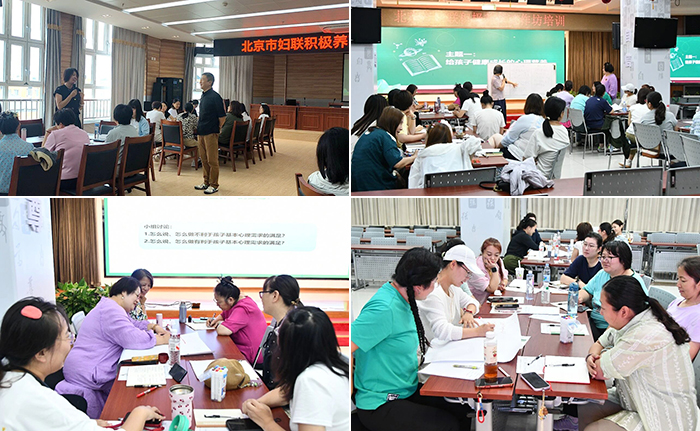
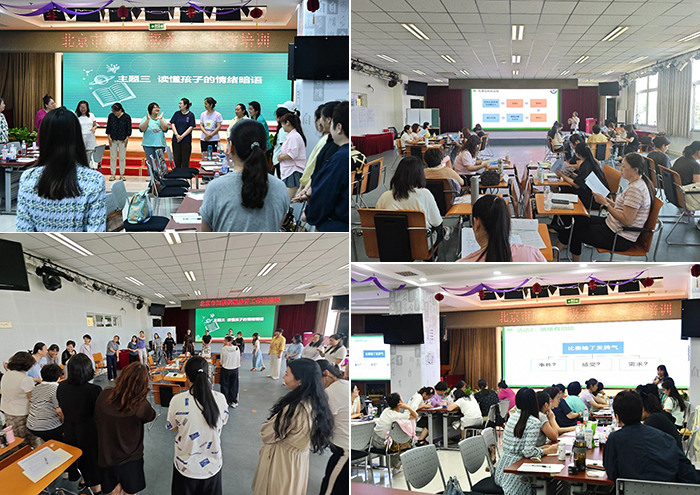
The participatory training model moves away from lengthy theoretical lectures and one-way knowledge delivery. Participants sit in groups to discuss practical issues, such as “How to set rules for children,” and engage in scenario-based simulations under expert guidance, drawing on their own experiences and insights through interaction.
“This was my first participatory training, and it was incredibly refreshing. I plan to apply this interactive sharing model to our community activities,” one participant said. Group discussions, case simulations, and the exchange of diverse perspectives became the norm, making psychological knowledge more tangible and applicable. Participants were no longer passive recipients of knowledge, but active sharers of experience, contributors of ideas, and co-solvers of problems.
Focusing on Mental Health and Enhancing Practical Skills
Centered on the concept of “positive parenting,” the workshop featured six thematic courses that translate the concept from an abstract idea into actionable methods. The curriculum covered understanding children’s psychological needs for competence, autonomy, and belonging, mastering practical parent-child communication skills, turning personal traits into strengths, and co-creating family rules that evolve with a child’s growth. The courses successfully balanced theoretical depth with practical application.
“The training corrected my ingrained habit of relying solely on past experience in raising children, giving me practical tools to accept my child’s emotions and communicate as equals,” one participant noted. Another added, “I have gained a new understanding of how to identify and utilize resources in family education, and I feel more confident in building and improving our service and support system for family education.” Such feedback highlights the profound impact of the training.
Leveraging Expertise for Sustained Empowerment
Supported by experts from the Beijing Family Education Research Association, the program adopted a “training plus supervision” model to ensure participants could effectively apply what they learned. Following the training, experts will provide on-site supervision and guidance for practical activities to help translate learning outcomes into real-world results.
Many participants have already begun planning their next steps. “Our community hosts many parent-child activities. In the future, we can use participatory approaches to encourage more interaction between parents and children,” one participant said. Another noted, “When holding classes at parent schools, we can incorporate scenario-based role-playing simulations so parents can better understand their children’s feelings.”
Following supervision and evaluation, outstanding participants will be selected to join the Association’s lecturer group for further training. These efforts will help build a professional grassroots family education guidance workforce through a tiered, targeted approach.
Going forward, the Beijing Women’s Federation will continue to strengthen the family education guidance workforce and channel resources toward frontline services, such as community parent schools. By shifting family education guidance from “fragmented provision” to “systematic empowerment,” the Federation aims to better meet the practical needs of families across the city.