Beijing Municipal Government Officially Releases the Beijing Women and Children’s Development Plan for the 15th Five-Year Plan Period, Advancing High-Quality Development of Women and Children’s Undertakings in the Capital to a New Level
Date:2026-9-2 17:25:31 Views: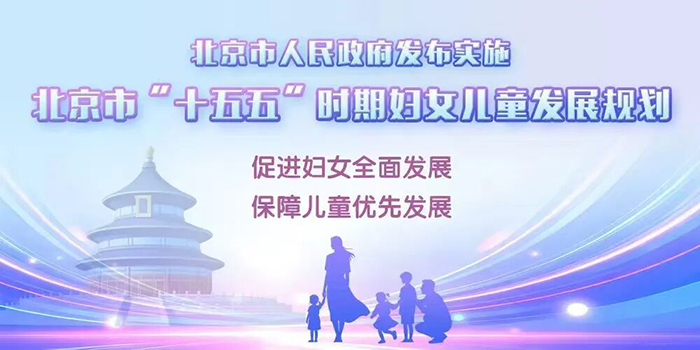
On September 1, the Beijing Municipal People’s Government officially issued the Beijing Women and Children’s Development Plan for the 15th Five-Year Plan Period (hereinafter referred to as the Plan). The Beijing Municipal Party Committee and the Municipal Government have always attached great importance to work related to women and children, incorporating the development of women and children into the city’s overall development planning and efforts. During the 14th Five-Year Plan period, Beijing achieved notable phased progress in the development of women and children’s undertakings. The overall development of women and children remained among the most advanced nationwide, and key indicators of maternal and child health reached internationally advanced levels. At a new starting point in its development, Beijing has formulated a new round of the Plan in line with the decisions and arrangements of the CPC Central Committee and the State Council, guided by the development of the capital in the new era and responsive to the evolving needs and expectations of women and children, so as to further promote coordinated development between women and children’s undertakings and economic and social development in the capital.
The formulation of the Plan focused on three key aspects. First, upholding the highest standards expected of the capital. Building on the achievements in the development of women and children during the 14th Five-Year Plan period, the Plan focuses on the high-quality development of the capital, scientifically sets development goals, and refines and implements corresponding tasks and measures. Second, adhering to a problem-oriented approach. In response to new challenges arising from changes in the population structure, adjustments to fertility policies, technological transformation, and changing lifestyles, the Plan proposes practical measures addressing key and difficult issues, including strengthening fertility and family support, promoting children’s physical and mental health, and empowering the development of women and children through digital technologies. Third, ensuring overall coordination and alignment. Women and children’s undertakings are incorporated into the overall consideration of Beijing’s economic and social development. The Plan implements the objectives and tasks set out in the Outline of Beijing’s 15th Five-Year Plan for National Economic and Social Development, promotes the integration of key tasks concerning women and children into relevant sectoral plans, and ensures that the Plan remains comprehensive, forward-looking, and sustainable.
The Plan sets the following main objectives: By 2030, institutional mechanisms promoting gender equality, the all-round development of women, and child-first development will be further improved; policies and measures for childbirth support and family support will continue to be improved; a child-friendly city will be fully developed; and the development of women and children will remain at the forefront nationwide and reach internationally advanced levels. By 2035, the development of women and children will be highly aligned with Beijing’s efforts to take the lead in basically realizing socialist modernization, and women and children will enjoy a full sense of fulfillment, happiness, and security. The Plan establishes 10 major indicators focusing on key areas in the development of women and children and issues of public concern. While aligning with the National Program for Women’s Development and the National Program for Child Development, it also sets higher targets based on the realities of the capital.
With a focus on promoting the all-round development of women and ensuring child-first development, the Plan sets out 59 key tasks across 15 areas. The tasks for promoting women’s all-round development cover eight areas: providing high-quality and accessible health services for women; improving the lifelong education system for women; promoting high-quality and full employment for women; ensuring women’s equal exercise of democratic rights in accordance with the law; strengthening multi-tiered social security for women; improving family support services; fostering a social environment that promotes gender equality; and strengthening legal protection of women’s rights and interests. The tasks for safeguarding children’s priority development cover seven areas: providing balanced and efficient health services for children; building a multi-dimensional child protection network; accelerating the development of a high-quality education system; improving an inclusive child welfare system; strengthening families’ capacity for child care and education; fully establishing a child-friendly city; and strengthening the legal safeguards for the protection of minors.
Based on the development of the capital in the new era and the all-round development of women and children, the Plan highlights the following features:
First, responding to the new normal of population development by building a comprehensive family support system spanning marriage and relationships, childbirth, and child-rearing. The Plan proposes concrete measures such as promoting the sharing of costs associated with childbirth and advancing the high-quality and inclusive development of integrated childcare and early education services. It also emphasizes supportive services such as creating a fertility-friendly employment environment and bringing domestic services into communities. These measures not only implement the decisions and arrangements for promoting long-term balanced population development but also serve as practical steps to strengthen family functions.
Second, responding precisely to emerging health needs among women and children by developing a health service system covering the entire life course. Addressing key and challenging issues such as cervical and breast cancers among women, as well as myopia, obesity, and mental health among children, the Plan introduces practical measures including endometrial cancer screening, the gradual expansion of HPV vaccination, and the implementation of the “Five Health” Promotion Action Plan for children and adolescents, demonstrating a more targeted approach to safeguarding the health of women and children throughout their lives.
Third, actively responding to the opportunities and challenges of the digital age through digital empowerment for the all-round development of women and children. Building on digital development, the Plan proposes creating jobs in digital technology, cultivating the “Jingwa” series of intelligent education agents, and further implementing the education digitalization strategy. It also calls for establishing a digital identity authentication system for minors and preventing illegal and criminal activities carried out through the internet and artificial intelligence technologies, thereby strengthening the online protection system.
Fourth, cultivating and strengthening the female talent workforce to support the integrated development strategy for education, science and technology, and talent. The Plan integrates women’s development into Beijing’s broader development agenda and proposes strengthening the training of female university students in key disciplines, improving the talent pool of female science and technology professionals, optimizing the development environment for female science and technology professionals, and enhancing women’s digital literacy and scientific literacy, enabling the power of women to become an important driving force in building Beijing into an international science and technology innovation center.
Fifth, focusing on the six-pronged protection system for minors and building a strong safeguard for their safety. In addition to addressing conventional areas such as campus safety and the safety of consumer goods, food, and medicines, the Plan introduces enhanced regulation of key areas including esports hotels, script-based entertainment venues, and study tours. It also strengthens comprehensive governance of illegal and criminal activities involving minors and systematically implements an integrated six-dimensional protection mechanism involving families, schools, society, cyberspace, government, and the judiciary.
Sixth, advancing citywide child-friendly development and making child priority an integral part of the capital’s urban character. With the goal of fully establishing a child-friendly city, the Plan promotes a shift from pilot programs to regularized citywide implementation, integrating the principle of child priority into public policymaking, public facility development, and public service provision, so that the concept of child-friendly development becomes more deeply embedded in public awareness and more widely put into practice.
The release of the Plan marks a new stage of high-quality development for women and children’s undertakings in the capital. Beijing will make every effort to ensure that all tasks are implemented and deliver tangible results in accordance with the highest standards expected of the capital. It will comprehensively improve the environment for the development of women and children, effectively safeguard the lawful rights and interests of women and children, and better meet the needs of women, children, and families for a better life. These efforts will further advance high-quality development of women and children’s undertakings in the capital and provide solid support for writing a new chapter of Chinese modernization in Beijing.